A Letter of Credit (LC) is a bank's written promise to pay an exporter once the exporter presents documents that exactly match the credit's terms. For exporters, it replaces the buyer's creditworthiness with a bank's — turning the risk of non-payment into a documentary exercise.
Selling across borders means dealing with buyers in different legal systems. Exporters fear shipping without guaranteed payment; importers fear paying before goods arrive. The LC resolves this standoff, and the global rulebook is the ICC's Uniform Customs and Practice for Documentary Credits (UCP 600). Knowing how to review an LC and present clean documents is the difference between getting paid on time and getting stuck in a dispute.
What Is a Letter of Credit and Why Exporters Rely on It
Under a documentary credit, the buyer's bank (the issuing bank) undertakes to pay the exporter (the beneficiary) against complying documents. Banks deal with documents, not goods — that separation is the whole point of the instrument.
Exporters use LCs for three reasons:
- Payment security. The bank, not the buyer, bears the payment obligation — protection against buyer insolvency, political instability and currency restrictions.
- Access to finance. A confirmed or irrevocable LC can be discounted or pledged to raise pre-shipment packing credit or post-shipment bill discounting from Indian banks.
- Predictable cash flow. Shipment and presentation windows are defined in advance, so working capital can be planned with confidence.
Types of Letter of Credit in Global Trade
1. Irrevocable vs Revocable LC
Under UCP 600 Article 3, every credit is deemed irrevocable even if it does not say so — it cannot be cancelled or amended without the agreement of all parties, including the exporter. Revocable credits, which let buyers cancel at will, are effectively obsolete in modern trade.
2. Confirmed vs Unconfirmed LC
In an unconfirmed LC, only the issuing bank is obliged to pay; the advising bank in India merely authenticates the credit. In a confirmed LC, a second bank (usually the exporter's own bank) adds its independent payment undertaking — so even if the foreign issuing bank defaults, the exporter still gets paid. Exporters selling to higher-risk markets should routinely insist on confirmation.
3. Sight vs Usance (Deferred Payment) LC
A sight LC pays promptly after the bank verifies complying documents (within five banking days of presentation). A usance LC gives the buyer a credit period — for example, 90 days from the bill of lading date — with the exporter holding the bank's deferred payment undertaking or an accepted time draft, which can often be discounted with a trade finance desk for early cash.
4. Transferable LC
A transferable LC lets the first beneficiary (often a trading house or export intermediary) transfer the credit, in whole or in part, to the actual manufacturer. This lets intermediaries broker trades without deploying their own capital, subject to invoice-substitution mechanics.
5. Back-to-Back LC
When the original LC is not transferable, the intermediary's bank issues a second, separate LC to the manufacturer, secured against the master export LC. This structure is costlier and harder to arrange because the bank takes on additional risk.
6. Red Clause and Green Clause LCs
A red clause LC authorises the advising bank to advance pre-shipment finance to the exporter against the credit, funding raw materials and production. A green clause LC is a variant where advances are conditional on the goods being held in an approved warehouse until shipment.
| LC Type | Key Benefit for Exporter | Risk Level | Best Suited For |
|---|---|---|---|
| Confirmed sight | Maximum security, fast payment | Lowest | New buyers, risky markets |
| Unconfirmed sight | No confirmation cost | Moderate | Strong foreign banks, stable markets |
| Usance / deferred | Offer credit terms with bank backing | Moderate–high | Competitive bids, long relationships |
| Transferable | Intermediaries trade without own capital | Medium | Merchant exporters, trading houses |
| Red clause | Pre-shipment working capital | Low for seller | Made-to-order goods, agriculture |
The UCP 600 LC Process in 7 Steps
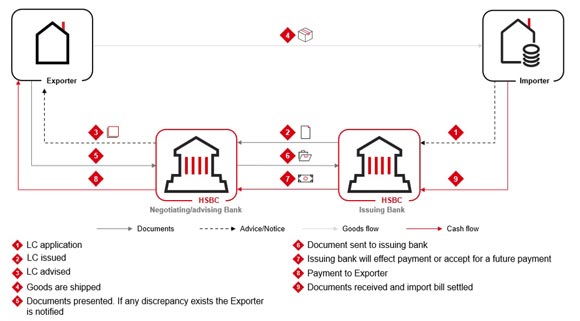
Step 1 — Contract and LC application. Buyer and exporter agree the sales contract: Incoterms, specifications, shipment date, documents and ports. The buyer then applies to its bank for the LC.
Step 2 — Issuance. The issuing bank opens the credit, usually via SWIFT MT700, listing every condition, required document and the expiry date.
Step 3 — Advising and confirmation. The issuing bank routes the LC through an advising bank in India, which notifies the exporter. A confirming bank may add its undertaking here. The exporter must check the LC text against the sales contract line by line before proceeding.
Step 4 — Shipment. The exporter produces the goods, arranges inspection, clears customs and ships within the latest shipment date, obtaining a clean on-board bill of lading.
Step 5 — Document presentation. The exporter compiles every required document and presents them to the nominated bank within the presentation period — by default 21 calendar days after shipment, and always before the LC expiry date.
Step 6 — Bank examination. Under UCP 600 Article 14(b), each bank has a maximum of five banking days following the day of presentation to decide whether the documents comply.
Step 7 — Settlement. Against complying documents the issuing bank pays — at sight or at maturity — and releases the documents to the buyer, who uses them to collect the cargo at destination.
The Doctrine of Strict Compliance and Common Discrepancies
UCP 600 Article 5 establishes the doctrine of strict compliance: banks examine documents, not the underlying goods. Even minor clerical errors give the issuing bank the legal right to refuse payment, issuing a formal notice of refusal (SWIFT MT734).
The discrepancies that most often kill payment:
- Late shipment — the bill of lading's on-board date falls after the LC's latest shipment date.
- Late presentation — documents presented after the LC expiry date or beyond 21 days from shipment.
- Invoice mismatch — the commercial invoice description does not correspond to the LC (Article 18(c)).
- Insurance shortfalls — cover below the required minimum (110% of CIF/CIP value under Article 28(f)(ii)) or effective only after loading.
- Inconsistent data — weights, package counts, shipping marks or container numbers differing across documents.
- Missing signatures or endorsements — unsigned invoices, unendorsed "to order" bills of lading, or missing stamps where the LC demands them.
When discrepancies surface, the buyer may waive them — or demand a price discount before accepting the documents. Either way, the exporter loses leverage, which is why pre-presentation auditing matters.
Exporter Document Checklist
- Commercial invoice — issued by the beneficiary, matching the LC on value, currency, Incoterms and goods description.
- Bill of lading / airway bill — clean, on-board, correctly consigned and endorsed; freight prepaid or collect as the LC requires.
- Packing list — package counts, gross and net weights, dimensions and shipping marks matching the transport document.
- Certificate of origin — from the chamber of commerce or export promotion council, referencing the invoice.
- Insurance certificate — in the same currency as the LC, covering the required risks for at least 110% of the invoice value.
- Pre-shipment inspection certificate — from the agency named in the LC, confirming quality, quantity and packing.
Bank Fees and Charges (Indicative)
LC costs vary by bank, country risk and trade volume. Treat the figures below as indicative and always confirm the tariff with your own bank:
- Advising fee — a flat charge for authenticating and delivering the LC.
- Confirmation fee — typically a quarterly or annual percentage, driven by the issuing bank's country risk.
- Negotiation / handling fee — for examining documents and processing payment, often a small percentage of invoice value subject to a minimum.
- Amendment fee — charged each time the LC terms, dates or values are changed.
- Discrepancy fee — deducted from the exporter's proceeds when the issuing bank finds errors in the documents.
Best practice: fix fee allocation in the sales contract itself — for example, "all banking charges outside the buyer's country are for the beneficiary's account".
Frequently Asked Questions
What happens if I cannot meet the latest shipment date in the LC?
Request an amendment through the buyer before shipping. Sailing late without a formal SWIFT amendment creates a late-shipment discrepancy, and the issuing bank may refuse to pay.
Can the issuing bank refuse payment if the buyer is unhappy with product quality?
No. Under UCP 600 Article 4, the credit is independent of the underlying sales contract — against complying documents, the bank must pay regardless of commercial or quality disputes.
How long does a bank have to examine documents under UCP 600?
A maximum of five banking days following the day of presentation, under Article 14(b).
Should I ask for a confirmed or an unconfirmed LC?
An unconfirmed LC relies solely on the foreign issuing bank. A confirmed LC adds your own bank's independent guarantee — worth the fee when selling to unfamiliar buyers or volatile markets.
Can an irrevocable LC be cancelled?
Only with the agreement of all parties: the issuing bank, the confirming bank (if any) and the beneficiary.
Who pays the discrepancy fee?
In practice it is deducted from the exporter's proceeds when the issuing bank finds errors in the presented documents.
Getting LC-Ready
Mastering documentary credits under UCP 600 turns payment risk into a process you control: read every credit against the sales contract, choose the right LC type for the market, and audit documents before presentation. Exporters who do this consistently get paid faster, finance cheaper and dispute less — a genuine competitive edge in global trade.