Poultry feed in Sri Lanka: feed types, suppliers, import rules, price factors and supplier verification for farmers and importers.
Poultry Feed in Sri Lanka – Suppliers, Prices & Import Guide
Poultry is one of Sri Lanka's most important livestock sectors, supplying eggs and chicken meat to households across the island. Feed is the largest cost in poultry farming, so the choice of feed, the supplier and the price matter more than almost any other decision a farmer or importer makes. This guide explains the feed types, the Sri Lanka market, the import rules, the price factors and how to verify a supplier.
Feed Types
Poultry feed is not a single product. It is a formulated ration, made to meet the nutritional needs of a particular type of bird at a particular stage of life. The main types are:
Starter feed. For young chicks in their first weeks, with higher protein to support rapid growth and development. It is usually sold as a fine crumble that small chicks can eat easily.
Grower feed. For older chicks and pullets that are growing but not yet laying, with a balance of protein and energy for steady growth.
Layer feed. For laying hens, with added calcium for eggshells and the right protein and energy for egg production. Layer feed is the most common type in Sri Lanka's egg sector.
Broiler feed. For meat birds, formulated for fast growth and efficient conversion of feed into meat. Broiler feed is usually sold in starter, grower and finisher stages, with the protein level falling as the bird grows.
Breeder feed. For parent stock, with a formulation that supports fertility, hatchability and chick health.
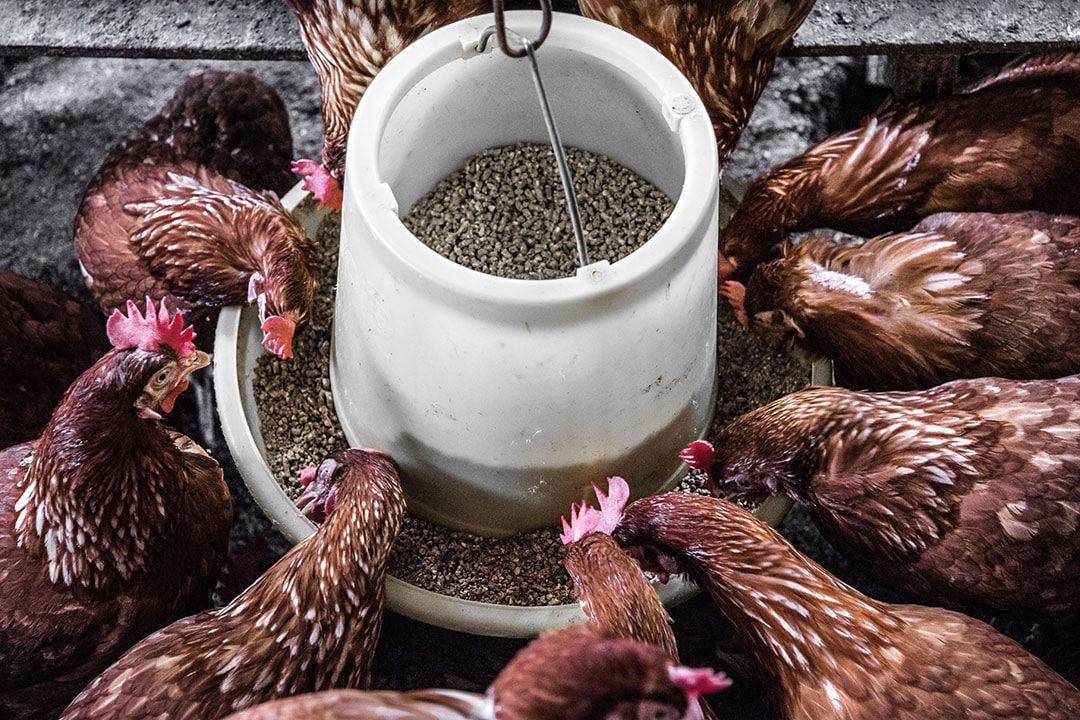
Feed is sold in several forms: mash (a loose powder), crumble (a coarse, broken pellet) and pellets (compressed feed). Pellets reduce waste and help birds eat evenly, while mash is cheaper and easier to make in small mills. The form matters for the farm's equipment and for the birds' age.
A complete feed is designed to be the bird's only feed, apart from water. A concentrate or premix is designed to be mixed with local grains, such as maize, before feeding. Buyers should be clear which type they are buying, and should follow the maker's mixing instructions if they buy a concentrate.
Sri Lanka Market
Sri Lanka's poultry sector is made up of large integrated companies, medium commercial farms and many small and backyard farms. Large companies often make their own feed in their own mills, while smaller farms buy ready-made feed from feed millers and dealers.
Feed millers are concentrated in the Western Province and in other poultry-producing areas, and they supply feed in bags, usually 25 kg or 50 kg, to farms through dealers and distributors. Some millers also supply day-old chicks, veterinary products and technical advice, so the feed supplier is often a wider partner for the farm.
Maize and soya are the main ingredients in poultry feed, and Sri Lanka imports much of its maize and soya meal, as well as some finished feed and feed additives. That import dependence means feed prices in Sri Lanka are linked to world prices for maize and soya, to shipping costs, and to the exchange rate.
For buyers, the market is practical rather than abstract: the questions are whether the feed is available in the quantity and type needed, whether the quality is consistent, and whether the price is fair for the formulation. A feed that is cheap but poorly formulated will cost more in the long run through poor growth, poor egg production or disease.
Import Rules
Importing poultry feed, feed ingredients or finished feed into Sri Lanka requires compliance with the country's import, animal health and food safety rules, which change from time to time. The points below are a guide, not a substitute for checking the current rules with the relevant authority or a customs broker before shipping.
Registration and permits. Feed and feed ingredients may need to be registered, and imports may need a permit from the animal production and health authorities. Check whether the product is on a list that needs approval, and what documents the authority needs.
Animal health and biosecurity. Imports of animal feed can carry disease risks, so the authorities may require a health certificate, a certificate of origin, and evidence that the product is free of certain contaminants. Some products may be restricted from certain origins.
Customs and duties. The HS code, the duty rate and any taxes should be confirmed for the exact product, whether it is finished feed, a concentrate, maize, soya meal or an additive. The duty can differ between finished feed and raw ingredients.
Labelling and quality. Imported feed should be labelled with the product name, the ingredients, the nutritional analysis, the batch number, the manufacturing date and the expiry date, in line with Sri Lankan rules. A laboratory analysis for the lot is often useful, and may be required.
Transport and storage. Feed should be kept dry and cool, and protected from pests and moisture during shipping and storage. Mouldy or damp feed can be harmful to birds, so check the condition on arrival.
Price Factors (Indicative Only)
Feed prices in Sri Lanka move with several factors, and any price seen online should be treated as indicative only. Verify the live price with the supplier before committing.
The main factors are:
- Maize and soya prices. These are the main cost in most poultry rations, and their world prices move with harvests, weather and trade.
- Exchange rate. Because much of the raw material is imported, a weaker Sri Lankan rupee raises feed costs.
- Formulation. Higher-protein starter and broiler feeds cost more than lower-protein grower feeds, and layer feeds with added calcium have their own cost.
- Form. Pellets usually cost more than mash, because of the extra processing.
- Volume and delivery. Larger orders and delivery to a farm near the mill are usually cheaper per bag than small orders delivered far away.
- Season and demand. Demand rises around festival periods and when poultry prices are high, which can lift feed prices.
Do not judge a feed by price alone. A cheap feed that gives poor growth or poor egg production is not a bargain. Compare feeds by their formulation, their nutritional analysis and their results on the farm, not just by the price per bag.
Supplier Verification
Feed quality affects bird health, growth and egg production, so verify a supplier before committing to a large order.
Ask for the business registration, a physical address, and references from other farms. Check that the miller has a mill, that it can show you its production and storage, and that it tests its raw materials and finished feed.
Ask for the formulation, the nutritional analysis and the ingredients list for the exact product, and check that they match what is printed on the bag. For a larger order, consider an independent laboratory test for protein, energy, moisture and, where relevant, contaminants such as aflatoxins.
Use a written agreement that states the product, the formulation, the quantity, the price, the delivery terms and the payment terms. Agree what happens if the feed does not match the specification. Use a payment method that gives you a record, and be cautious of a supplier who will not share a formulation or a test result, or whose price is far below the market.
Visit the mill or the supplier's premises where possible, and start with a trial order. Feed the trial batch to a small group of birds, check the results, and only then commit to a larger order.
How to Find Poultry Feed Buyers and Suppliers
Be specific about what you need: feed type, bird type and age, quantity, form, destination and delivery date. A clear enquiry gets a faster, more useful answer.
Browse importers in the TodayAdviser buyer directory at TodayAdviser Importers Directory, and shortlist buyers and suppliers who handle animal feed, poultry products or agricultural inputs. If you are selling, post your offer so buyers can find you: Post a Requirement on TodayAdviser.
When you contact a new partner, verify them as described above, start with a trial order where possible, and build the relationship over time. In the feed trade, consistent quality and reliable delivery matter more than a one-off cheap price.
Frequently Asked Questions
What is the best poultry feed in Sri Lanka?
There is no single best feed. The right feed depends on the bird type, age and purpose — starter, grower, layer or broiler — and on the farm's management. Compare feeds by formulation, nutritional analysis and results, not just by price.
How much does poultry feed cost in Sri Lanka?
Prices vary by feed type, formulation, volume and delivery, and they move with maize and soya prices and the exchange rate. Treat any price online as indicative only, and check the live price with the supplier.
Can I import poultry feed into Sri Lanka?
It depends on the product and the current rules. Check whether the feed or ingredient needs registration or a permit, what health and customs documents are needed, and what duty applies, with the relevant authority or a customs broker before shipping.
What is the difference between mash, crumble and pellets?
Mash is a loose powder, crumble is a coarse broken pellet, and pellets are compressed feed. Pellets reduce waste and help birds eat evenly, while mash is cheaper. The best form depends on the birds' age and the farm's equipment.
How should poultry feed be stored?
Keep it in a cool, dry place, in a sealed container or on a raised pallet, away from moisture and pests. Use it within the maker's recommended period, and discard any feed that is mouldy, damp or smells off.
What should I check before buying feed from a new supplier?
Business details, references, formulation and nutritional analysis, a sample from the actual lot, a written agreement, and a trial order with a small group of birds before committing to a large order.
Conclusion
Poultry feed is the largest cost in poultry farming in Sri Lanka, and it is also the largest lever for better growth, better egg production and healthier birds. Know the feed type you need, understand the price factors, check the import rules for the product you are buying, and verify the supplier before you commit. A reliable supplier, a clear formulation and a trial order are the best protection against a costly mistake, whether you are buying for a small farm or importing for a larger operation.