Rules of origin decide whether exported goods qualify for zero-duty or reduced tariffs under Free Trade Agreements. This 2026 guide explains how to navigate substantial transformation, calculate RVC, interpret PSR schedules, and protect duty claims.
Your buyer's customs duty can be the difference between winning and losing an export order. Under India's free trade agreements, your goods can enter partner markets at zero or reduced duty — but only if they are genuinely "Indian" under the agreement's rules of origin. Get the origin call wrong, and your buyer pays full MFN duty, or worse, faces a denial and penalties. This guide explains how rules of origin work, the tests your product must pass, and how to claim FTA duty benefits in 2026.
What Rules of Origin Mean
Rules of origin are the legal criteria that determine the "economic nationality" of a product — the country it is deemed to come from for trade purposes. Every FTA contains a dedicated rules-of-origin chapter, usually with a product-specific rules annexure, that decides which goods qualify for the agreement's tariff concessions.
Why they matter to you as an exporter: a certificate of origin is only as good as the origin analysis behind it. If your product does not satisfy the FTA's origin rule, the preferential certificate is invalid, the buyer loses the duty benefit, and you may face commercial claims. Origin is a compliance exercise, not a paperwork formality.
Wholly Obtained vs Substantial Transformation
Origin rules recognise two routes:
Wholly obtained goods are produced entirely in one country without foreign inputs: minerals extracted, crops harvested, animals born and raised, fish caught by domestic vessels, and goods manufactured exclusively from such materials. Basmati rice grown and milled in India, for example, is wholly obtained.
Substantially transformed goods use imported inputs but undergo enough processing in the exporting country to earn origin. Most manufactured exports fall here. Substantial transformation is demonstrated through one of the tests below — and this is where exporters need to do real analysis.
The Two Main Tests: Value Addition and Change in Tariff Heading
1. Regional value content (RVC) — the value-addition test. A minimum percentage of the product's value must originate in the FTA territory. The usual formula is:
RVC = (FOB value minus value of non-originating materials) divided by FOB value, multiplied by 100
If the agreement requires 40 per cent RVC and your calculation shows 45 per cent, the product qualifies on this test. Keep auditable cost records — customs authorities can ask for them years later.
2. Change in tariff classification (CTC). The finished product must fall under a different HS chapter, heading or sub-heading from each non-originating input. Strictness varies: change in chapter (CC) is the hardest, change in heading (CTH) is common, and change in sub-heading (CTSH) is the lightest. Many agreements combine both tests — for example, "CTH plus 40 per cent RVC".
3. Specific process rules. Some agreements list qualifying operations, such as a defined chemical reaction or refining step, that confer origin regardless of classification change.
Always check whether the agreement allows cumulation — inputs from the FTA partner counting as originating — and de minimis or tolerance provisions, under which a small percentage of non-originating material that fails the CTC test is ignored.
Product-Specific Rules (PSRs): How to Read Them
The PSR annexure lists the origin rule for every HS heading. Reading it is a three-step habit:
- Classify your finished product correctly — 6-digit HS first, then the national tariff line.
- Find the rule for that line. It will state a CTC requirement, an RVC percentage, a process rule, or a combination.
- Apply it to your actual bill of materials, using real supplier costs and the correct classification of each input.
Classify inputs correctly too — a wrong input HS code silently breaks the CTC analysis. When in doubt, get a professional classification view rather than guessing.
Preferential vs Non-Preferential Certificates of Origin
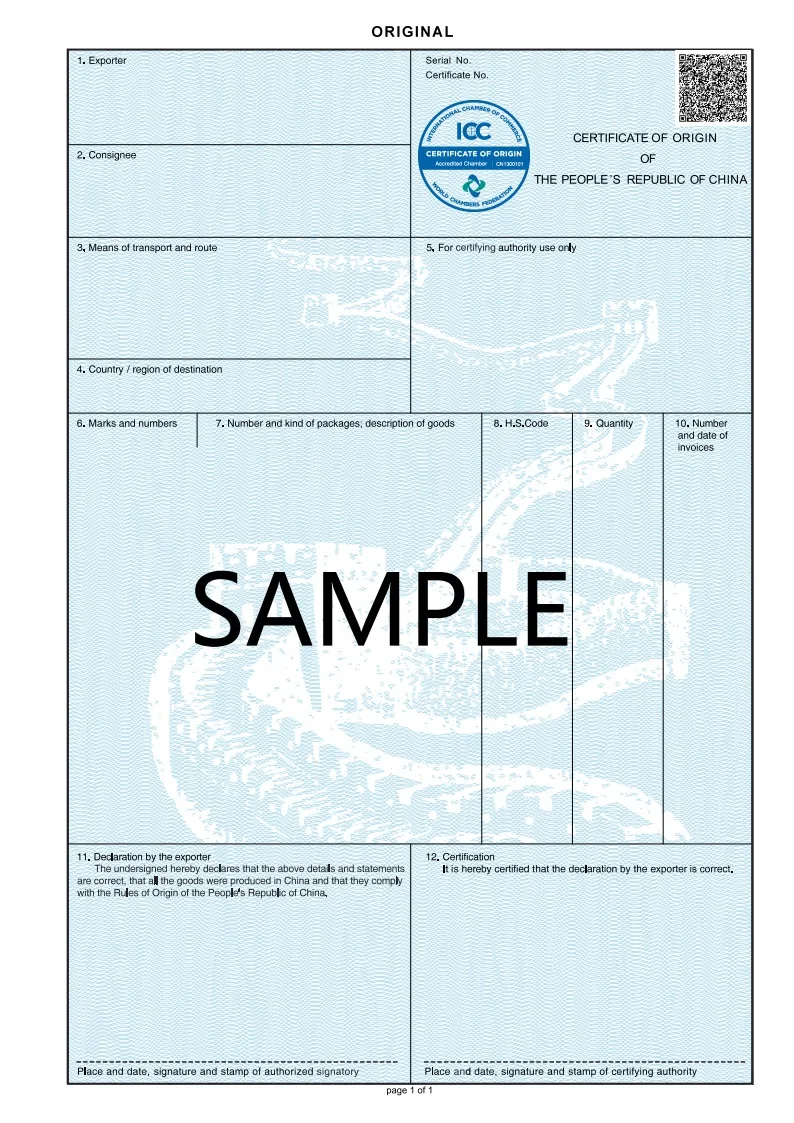
A preferential certificate of origin is issued under a specific FTA — India–UAE CEPA, India–UK FTA and similar agreements — and is the document your buyer presents to claim reduced duty. In India, these are issued through DGFT's common digital platform (eCoO) by authorised agencies including export promotion councils and chambers of commerce.
A non-preferential certificate of origin simply certifies where goods were made, without claiming any duty benefit. Buyers often require it under letters of credit or for their own import compliance. Do not confuse the two: a non-preferential certificate never earns FTA duty rates.
Note the mirror image on the import side: India's CAROTAR Rules, 2020 require importers claiming FTA benefits to hold detailed origin information. Expect your buyers' customs authorities to apply similar scrutiny to your certificates.
Worked Examples: India–UAE CEPA, India–UK FTA, India–New Zealand FTA
Example 1 — Garments under the India–UAE CEPA. A garment made in India from imported fabric: check the PSR for the garment's HS heading. Under the CEPA, many products follow a general rule of around 40 per cent value addition, often combined with a change in tariff heading. The fabric (a different heading from the finished garment) can satisfy the CTH limb, and you then verify that Indian value addition — cutting, stitching, finishing and overheads — reaches the required percentage of FOB. Document both limbs.
Example 2 — Engineering goods under the India–UK FTA. A pump assembled in India from imported components: find the PSR for pumps in the agreement's schedule. Map each component's HS code against the pump's heading, compute the regional value content from supplier invoices, and confirm how any UK-origin parts are treated under the agreement's cumulation provisions.
Example 3 — Food products under the India–New Zealand FTA, going live on 20 October 2026. A processed food product using some imported ingredients: well before the first shipment, run the PSR for the product line, confirm whether wholly-obtained or substantial-transformation rules apply, and line up your CoO issuing agency so the first consignment can claim the preferential rate from day one.
These are illustrative frameworks — always verify the live PSR text for your exact HS line before quoting duty benefits to a buyer.
Common Mistakes That Cost Exporters Duty Benefits
- Treating a "Made in India" label as proof of origin. Origin is a legal test, not a marketing claim.
- Failing to keep supplier declarations and cost workings for non-originating inputs.
- Misclassifying the finished product or its inputs, which invalidates the CTC analysis.
- Ignoring the direct-consignment rule: goods routed through a third country may need to remain under customs control in transit to keep originating status.
- Issuing the CoO without checking the agreement's timelines and retroactive-issue provisions.
Frequently Asked Questions
Who issues a preferential certificate of origin in India?
Authorised agencies — including export promotion councils and chambers of commerce — issue them through DGFT's eCoO digital platform. Apply with the invoice, packing list and origin-supporting documents.
Does the FTA benefit apply automatically once I have the CoO?
No. Your buyer must present the CoO to their customs at import and claim the preference. Brief your buyer on the process — an unclaimed CoO earns nothing.
What records should I keep to defend an origin claim?
Bills of materials, supplier invoices showing input origin, cost workings for the RVC calculation, classification notes, and copies of issued CoOs — retained for the period the agreement prescribes.
Can I use inputs from the FTA partner country?
Generally yes. Most agreements allow cumulation, meaning partner-country inputs count as originating. Confirm this in the specific agreement's origin chapter.
What happens if customs disputes the origin?
The buyer's customs may deny the preference and demand full duty, sometimes with penalties. Verification requests can travel back to the issuing agency in India. Solid records are your only defence.
Do FTAs cover services as well?
Services origin works differently — it turns on rules about service suppliers rather than goods. This guide covers goods; check the services chapter of each agreement separately.
Conclusion
Rules of origin reward exporters who manufacture genuinely in India — and punish those who treat the certificate as a rubber stamp. Build origin analysis into your costing and documentation routine: classify correctly, compute value content honestly, keep records, and issue the right certificate through the right channel. Done properly, FTA duty benefits become a durable pricing advantage rather than a compliance gamble.