Mastering cold chain logistics for perishable exports from India requires absolute precision across temperature maintenance, equipment handling, and international regulatory compliance. From the moment high-value perishables—such as Alfonso mangoes, farm-raised vannamei shrimp, or finished pharmaceutical biologics—leave processing facilities in Nashik, Nellore, or Hyderabad, any deviation in thermal parameters can destroy product value, compromise cargo safety, and trigger commercial rejections at destination ports in Rotterdam, Jebel Ali, or Newark.
For Indian exporters, international cold chain logistics involves coordinating advanced refrigerated containers (reefers), certified pre-cooling infrastructure, uninterrupted genset power across road transits, disciplined port-terminal handling, and seamless multi-country compliance frameworks. Successfully navigating this landscape means designing supply chains that survive systemic friction points, equipment shortages, and customs-related dwell times.
This practical guide provides an end-to-end operational blueprint for B2B exporters and global supply chain managers handling Indian perishables, covering equipment dynamics, vulnerability mapping, regulatory contrasts between food and pharmaceutical goods, digital monitoring technologies, partner selection, and operational budgeting.
Reefer Container Fundamentals and Cargo Temperature Requirements
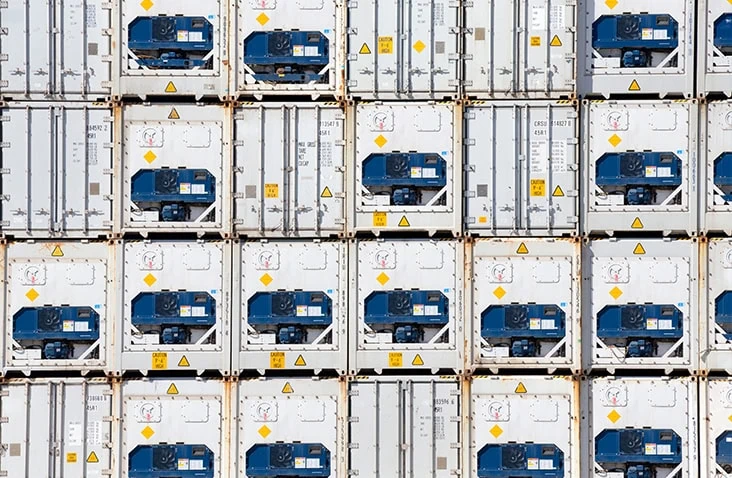
Refrigerated shipping containers, or reefers, are active cooling systems designed to maintain, rather than reduce, cargo temperature during transit. A reefer functions through forced bottom-air delivery: chilled air is driven through the base via T-bar decking, rises through the cargo stack, and returns to the cooling machinery via the ceiling bulkhead. Maintaining uninterrupted airflow requires correct cargo configuration and strict adherence to internal load lines.
Understanding the physiological and physical demands of different commodities dictates equipment programming. Perishables fall into distinct thermal, humidity, and atmospheric categories.
Chilled Produce and Respiration Management
Unlike frozen goods, live perishables like fresh fruit, vegetables, and floriculture continue to respire after harvest. Respiration consumes oxygen ($O_2$) and produces carbon dioxide ($CO_2$), ethylene gas, and internal metabolic heat. If ethylene and $CO_2$ accumulate inside an airtight container, produce ripening accelerates rapidly, leading to senescence and tissue breakdown before arrival.
To manage this, modern reefers feature adjustable fresh air ventilation settings (measured in cubic meters per hour, CBM/hr, or cubic feet per minute, CFM) to continuously exhaust ethylene and replace $CO_2$ with fresh atmospheric air. For highly sensitive, long-transit commodities like marine-shipped table grapes or premium mangoes, Controlled Atmosphere (CA) technology actively monitors and modifies internal gases, maintaining oxygen levels at 2–5% and carbon dioxide levels at 3–10% to place the produce into a dormant metabolic state.
Deep-Frozen Food Cargoes
Marine products, specifically frozen shrimp and cephalopods, alongside frozen bovine meat, require deep-freeze temperatures, typically -18°C or -20°C. For these items, fresh air ventilation must remain 100% closed. Opening ventilation on frozen cargo introduces warm, humid ambient air, creating immediate condensation, frost accumulation across the container's evaporator coils, frequent defrost cycling, and localized freeze-thaw burn on the cargo outer packaging.
Cargo Temperature, Humidity, and Ventilation Parameters
The table below outlines baseline reference parameters for major perishable export lines originating in India. Values are indicative and must be confirmed against product-specific buyer specifications, cultivar traits, and pre-shipment protocols.
| Export Commodity Category | Target Set-Point Temp (°C) | Relative Humidity (RH %) | Fresh Air Ventilation (CBM/hr) | Controlled Atmosphere (CA) Required? |
|---|---|---|---|---|
| Fresh Table Grapes (Thomson Seedless) | -0.5°C to 0.0°C | 90% – 95% | Closed (with $SO_2$ pads) or low | Optional; recommended for >21 day transit |
| Fresh Mangoes (Alphonso, Kesar) | +10.0°C to +13.0°C | 85% – 90% | 15 – 25 CBM/hr | Strongly recommended for sea freight to EU/US |
| Fresh Pomegranates (Bhagwa) | +5.0°C to +7.0°C | 90% – 95% | 10 – 15 CBM/hr | Beneficial for transit times exceeding 18 days |
| Frozen Vannamei Shrimp (IQF/Block) | -18.0°C to -22.0°C | N/A (Sealed packaging) | Strictly Closed (0 CBM/hr) | No |
| Frozen Boneless Buffalo Meat | -18.0°C to -20.0°C | N/A (Sealed packaging) | Strictly Closed (0 CBM/hr) | No |
| Fresh Cut Flowers (Roses, Carnations) | +1.0°C to +2.0°C | 90% – 95% | Low (5 – 10 CBM/hr) | No (typically air freighted) |
| Biopharma Formulations / Vaccines | +2.0°C to +8.0°C | Non-condensing (<60%) | Strictly Closed (0 CBM/hr) | No (strict GDP validation required) |
| Small Molecule Active Ingredients (API) | +15.0°C to +25.0°C | Ambient controlled | Strictly Closed (0 CBM/hr) | No (thermal profiling needed) |
Critical Vulnerability Points: Where Temperature Breaks Happen
A temperature break—a loss of thermal integrity where cargo leaves its target operating envelope—rarely occurs while a vessel is cruising on the high seas. Over 90% of cold chain failures take place at transfer nodes, during handling handoffs, or due to procedural errors prior to vessel loading.
[ Packhouse Pre-Cooling ] ──(Thermal Shock)──> [ Factory Stuffing ]
                                                       │
                                                 (No Clip-On Genset)
                                                       ▼
[ Port Gate-In Dwell ] <──(Off-Power Transport)── [ First-Mile Drayage ]
        │
 (Terminal Unplugged)
        ▼
[ Transshipment Hub ] ──(Omission / Re-stow)──> [ Last-Mile Delivery ]
1. Stuffing at Origin Packhouses and the Pre-Cooling Fallacy
The most frequent operational mistake made by emerging exporters is failing to pre-cool the produce prior to containerization while simultaneously running the reefer container with its doors open during stuffing.
Reefer container refrigeration units lack the thermodynamic capacity to function as blast chillers. If warm produce (+28°C to +32°C ambient field temperature) is loaded directly into a container, the unit's cooling cycle becomes overloaded. Furthermore, if the reefer unit is switched on while container doors remain open during loading, warm, moist ambient air is drawn directly into the evaporator coils. This creates rapid ice build-up on the coils, triggering repeated, automatic defrost cycles that heat the container interior and cause thermal shock to the cargo.
Rule of thumb: Always pre-cool the cargo to core storage temperature in a specialized packhouse cold room before stuffing. Turn the reefer machinery off while the container doors are open, and use insulated loading dock seals whenever accessible.
2. First-Mile Drayage and Road Transport Vulnerabilities
In India, agricultural packhouses and manufacturing clusters are often located hundreds of kilometers away from primary gateway ports like JNPA (Nhava Sheva), Mundra, or Chennai. Transporting a loaded reefer across Indian highways without an active auxiliary power source introduces significant risk.
Using specialized "clip-on" or "underslung" generator sets (gensets) is essential for any road transit exceeding four to six hours for chilled goods. While deep-frozen cargo has thermal mass and can withstand brief periods off-power if properly palletized and sealed, ambient temperatures exceeding +40°C during Indian summer months will cause the perimeter cargo (top, sides, and rear doors) to absorb radiant heat, causing localized thaw and re-freezing that degrades product texture and quality.
3. Port Terminals and Dwell Times
Once a container passes the port gates, responsibility transfers to the marine terminal operator. Key breakdown points occur during:
- Gate-to-Plug Lag: The time between terminal gate-in and the moment the reefer is physically moved to the reefer yard and connected to shore power. In congested gateway terminals, this window can stretch to 8–18 hours if not actively managed by an on-site clearance team.
- Customs Examination Holds: If a container is flagged for physical inspection by Indian Customs, the Food Safety and Standards Authority of India (FSSAI), or plant quarantine authorities, it must be unplugged, moved to an inspection bay, destuffed, inspected, and restuffed. If the inspection bay lacks cold storage infrastructure, the entire shipment experiences direct ambient exposure.
4. Transshipment Hub Delays
Direct sea connections from India to final markets are not always available, requiring transshipment through hubs like Colombo, Jebel Ali, or Singapore. During transshipment, containers face several distinct risks:
- Equipment being off-power during crane transit between vessels.
- Containers missing feeder vessel connections due to schedule disruptions, leading to extended, unmonitored dwell times in intermediate terminal yards.
- Accidental human error by terminal operators failing to reconnect shore power or improperly recording the reefer plug-in state in terminal management systems.
5. Destination Clearance and the Final-Mile Handover
At the destination port, delays frequently occur during customs verification, veterinary checks, and final transport. If an importer lacks certified temperature-controlled transport for port-to-warehouse drayage, the final hour of delivery can ruin an otherwise stable multi-week journey.
Regulatory Frameworks: Food Cold Chain vs. Pharma GDP
While food and pharmaceuticals share cold chain logistical hardware, their compliance environments differ substantially. Exporting food requires compliance with biological safety and phytosanitary metrics; exporting pharmaceuticals requires validated, auditable distribution frameworks.
                  ┌────────────────────────────────────────┐
                  │   COLD CHAIN COMPLIANCE FRAMEWORKS    │
                  └───────────────────┬────────────────────┘
                                      │
             ┌────────────────────────┴────────────────────────┐
             ▼                                                 ▼
┌───────────────────────────────┐               ┌───────────────────────────────┐
│      FOOD LOGISTICS RULES     │               │   PHARMA GDP (WHO / PIC/S)   │
├───────────────────────────────┤               ├───────────────────────────────┤
│ • Visual & organoleptic grade │               │ • Complete lane qualification │
│ • APEDA / MPEDA / FSSAI       │               │ • Continuous NIST calibration │
│ • Maximum Residue Limits (MRL)│               │ • 21 CFR Part 11 electronic   │
│ • Pest / quarantine clearance │               │   audit trails                │
│ • Cold treatment protocols    │               │ • Validated thermal packaging │
└───────────────────────────────┘               └───────────────────────────────┘
Food Cold Chain Frameworks
Food products exported from India are governed by specific statutory authorities:
- APEDA (Agricultural and Processed Food Products Export Development Authority): Mandates standards for packhouses, cold storage units, and phyto-quarantine facilities for exports of table grapes, mangoes, and vegetables.
- MPEDA (Marine Products Export Development Authority): Oversees traceability, residue limits, and sanitary conditions across cold storage facilities handling seafood.
- Importing Market Regulations: Exporters targeting the United States must comply with the US FDA Food Safety Modernization Act (FSMA), specifically the Sanitary Transportation of Food rule. Exports destined for the European Union require adherence to the General Food Law (Regulation EC 178/2002) and strict microbiological and pesticide Maximum Residue Limits (MRLs).
Additionally, many importing countries impose mandatory Cold Treatment Protocols as a phytosanitary measure against pests like the Mediterranean fruit fly. Under these protocols, the core pulp temperature of the fruit must be maintained continuously at a precise level (e.g., +1.1°C or below for 14 to 16 consecutive days) during transit. If a calibrated sensor shows an excursion above this threshold for even 30 minutes, the treatment fails, and the shipment faces rejection or mandatory incineration upon arrival.
Pharmaceutical Good Distribution Practice (GDP)
Pharmaceutical cold chain logistics operates under strict quality-by-design standards guided by WHO Annex 5, US FDA 21 CFR Part 211, and the European Medicines Agency (EMA) GDP guidelines (2013/C 343/01). The differences between food and pharmaceutical logistics are clear:
- Thermal Mapping and Lane Qualification: For pharmaceuticals, shipping containers and transport routes must undergo formal qualification (Design, Installation, Operational, and Performance Qualification—DQ/IQ/OQ/PQ). Exporters cannot simply book a generic reefer without pre-qualifying the equipment, route lanes, and seasonal variations.
- Data Integrity and 21 CFR Part 11: Pharma data loggers must record temperature continuously at short intervals. Digital records must be non-editable, cryptographically secure, and provide full audit trails.
- Chain of Custody and Calibration: Every measurement device used must carry unbroken traceability to NIST (National Institute of Standards and Technology) or equivalent national metrological standards. Any temperature excursion must be documented via a formal CAPA (Corrective and Preventive Action) investigation.
Side-by-Side Regulatory Matrix
| Compliance Dimension | Food Cold Chain Logistics | Pharmaceutical GDP Logistics |
|---|---|---|
| Primary Oversight (India) | APEDA, MPEDA, FSSAI | CDSCO (Central Drugs Standard Control Organisation) |
| Primary Global Standards | Codex Alimentarius, US FSMA, EU Food Law | WHO TRS 961, PIC/S Guide to GDP, US FDA, EMA GDP |
| Equipment Validation | Routine Pre-Trip Inspection (PTI) by shipping lines | Comprehensive seasonal mapping & physical lane qualification |
| Excursion Thresholds | Based on product decay, firmness, shelf-life | Strict release specifications; deviation demands formal investigation |
| Data Logging Requirements | Single-use/basic data loggers; pulp probes for cold treatment | Real-time active IoT, NIST-traceable, 21 CFR Part 11 compliant |
| Packaging Strategy | Ventilated corrugated cartons, pallet netting, $SO_2$ pads | Qualified passive thermal shippers, phase change materials (PCMs) |
Monitoring, Visibility, and Cold Chain Telemetry
Relying solely on a reefer's built-in data recorder is a flawed logistics strategy. Built-in modems track the supply and return air temperatures at the cooling unit face, but they fail to capture the micro-climate inside the individual pallets situated toward the container doors.
Evolution of Temperature Monitoring Hardware
- Single-Use USB Data Loggers: Cost-effective and widely deployed for standard commodity exports. Inserted directly into cartons during packing, they record temperatures at set intervals. The core limitation: data is completely inaccessible until the container arrives at the final destination and the device is manually retrieved and plugged into a computer. If an excursion occurred on day two, no proactive interventions are possible.
- Active Cellular and Satellite IoT Telemetry: Modern cold chain operations use dynamic IoT devices equipped with multisensor capabilities: temperature, relative humidity, light (indicating unauthorized door openings), shock, and geographic location. Using 4G/5G and multi-network global SIM cards, these devices transmit real-time telemetry to cloud-based supply chain management platforms. When ships are out at sea, higher-end setups leverage vessel-based bridge transponders or store-and-forward buffers that broadcast the complete journey log immediately upon reconnecting to terrestrial networks.
Strategic Placement of Monitoring Devices
Placing a data logger in an incorrect location will generate misleading data. For a standard 40-foot High-Cube reefer, loggers should be deployed strategically:
- Sensor 1 (Intake Reference): Located at the front bulkhead near the bottom return-air inlet to verify the baseline delivery temperature from the reefer machinery.
- Sensor 2 (Core Cargo Mass): Positioned inside a carton in the geometric center of the load, tracking internal mass temperature rather than fluctuating ambient air.
- Sensor 3 (Thermal Hotspot): Placed in the top layer of the pallet closest to the rear doors. This is the thermodynamically weakest zone of any reefer container, as heat penetrates through the door seals and cooling airflow is weakest at the far end of the T-floor.
                                REEFER INTERNAL PROFILE
  ┌────────────────────────────────────────────────────────────────────────┐
  │ [Cooling Unit]                                           [Rear Doors]  │
  │                                                                        │
  │  ┌───────────┐      ┌───────────┐      ┌───────────┐      ┌──────────┐ │
  │  │ Pallet 1  │      │ Pallet .. │      │ Pallet .. │      │Pallet End│ │
  │  │ [Sensor 1]│      │           │      │ [Sensor 2]│      │[Sensor 3]│ │
  │  │(Air Intake│      │           │      │(Center-   │      │(Rear Hot-│ │
  │  │   Area)   │      │           │      │ Core Mass)│      │   Spot)  │ │
  │  └───────────┘      └───────────┘      └───────────┘      └──────────┘ │
  │================== T-BAR FLOOR AIRFLOW (Bottom to Top) =================│
  └────────────────────────────────────────────────────────────────────────┘
Handling Insurance Claims via Electronic Proof of Condition
When a thermal breakdown occurs, shipping lines and marine cargo underwriters demand concrete proof to determine liability. To establish a successful insurance or carrier claim:
- Maintain records of pre-cooling pulp logs signed by the QC manager before container stuffing.
- Retain the signed Equipment Interchange Receipt (EIR) verifying container conditions upon arrival and departure.
- Download the native proprietary data from the reefer unit itself (the manufacturer's controller log—Carrier DataCOLD, Thermo King, Daikin, or Star Cool) alongside third-party IoT records.
- Demonstrate that the exporter observed correct packaging configurations and did not stack cargo above the marked maximum load line (the red horizontal line along the interior walls).
Selecting Specialized Cold Chain Forwarders and CHAs
General freight forwarders and standard Customs House Agents (CHAs) often fail to grasp the time-sensitive nature of perishable cargo. A single clearance delay during an Indian holiday weekend can wipe out the commercial value of a shipment.
Evaluating a Cold Chain Freight Forwarder
When vetting potential freight forwarding partners, move past generic pricing negotiations and directly audit their operational capabilities:
- Dedicated Reefer Desk: Does the forwarder maintain a round-the-clock specialized reefer desk, or is perishable cargo routed through standard dry-container operating teams?
- Carrier Allocations and Equipment Access: In periods of global trade imbalances, empty 40ft High-Cube reefer boxes face chronic shortages at Indian inland container depots (ICDs). Can the forwarder demonstrate formal equipment allocation contracts with tier-1 shipping lines?
- Genset Management Protocols: What written standard operating procedures (SOPs) exist for genset failures during first-mile drayage? Do they have emergency maintenance contracts with service providers along the transit corridor?
- Plug-in Monitoring Service Level Agreements (SLAs): Does the forwarder guarantee written reports on container plug-in status and temperature checks at the port terminal every 12 hours?
Vetting the Customs House Agent (CHA)
The CHA handles the critical operational interface between cargo, customs officials, port health officers, and quarantine labs. Essential criteria include:
- On-Site Presence at Gateways: The CHA must have dedicated operational staff present directly at port container yards (e.g., JNPA, Mundra, or Kochi) rather than outsourcing tasks to third-party sub-agents.
- Familiarity with ICEGATE and Allied Agency Workflows: The CHA must understand the regulatory mechanisms of the Food Safety and Inspection System, Plant Quarantine Information System (PQIS), and the Central Drugs Standard Control Organisation (CDSCO). They must know how to secure accelerated sampling appointments to avoid broken seal dwell times.
- Emergency Infrastructure: If a physical customs inspection is ordered, can the CHA secure access to a temperature-controlled container freight station (CFS) to prevent cargo exposure to ambient heat during inspection?
Total Landed Cost Drivers in Cold Chain Logistics
Cold chain transport costs substantially exceed dry freight shipping rates. Exporters must construct their export sales contracts—whether CIF, CFR, or DDP—accounting for several compounding operational variables.
                          TOTAL COLD CHAIN COST STACK
┌─────────────────────────────────────────────────────────────────────────┐
│ Ocean / Air Freight Base Rate (Specialized Reefer Capacity)             │
├─────────────────────────────────────────────────────────────────────────┤
│ Pre-Trip Inspection (PTI) & Structural Sanitization Charges             │
├─────────────────────────────────────────────────────────────────────────┤
│ First-Mile Clip-on Genset Lease & Diesel Consumption Fuel Surcharges    │
├─────────────────────────────────────────────────────────────────────────┤
│ Terminal Electricity & Monitoring Fees (Plug-in surcharges at Port/CFS) │
├─────────────────────────────────────────────────────────────────────────┤
│ Active IoT Telemetry Hardware & SaaS Monitoring Subscription Fees       │
├─────────────────────────────────────────────────────────────────────────┤
│ Elevated Reefer Demurrage & Detention Liabilities                       │
└─────────────────────────────────────────────────────────────────────────┘
1. Ocean and Air Base Reefer Rates
Ocean reefer freight commands a 40% to 120% premium over equivalent dry container lanes due to capital costs of equipment, ongoing machinery maintenance, energy consumption on board, and unbalanced global empty equipment repositioning flows. In air freight, perishable capacity requires dedicated temperature zones within airline hub cool facilities, attracting baseline perishable surcharges ($/kg).
2. Pre-Trip Inspection (PTI) Charges
Before an empty reefer is released to an exporter, the carrier performs a comprehensive technical Pre-Trip Inspection (PTI). During this process, technicians run diagnostic tests on the cooling system, check compressor oil levels, calibrate sensors, verify refrigerant levels, and inspect structural walls for insulation damage. Exporters typically pay a dedicated PTI charge, which may include specialized high-grade washing for hygiene-sensitive cargo.
3. Genset Rental and Road Transit Energy Costs
Leasing a mobile diesel generator set for first-mile highway transport involves dual costs: daily equipment rental plus current diesel fuel burn rates. Depending on ambient conditions, a clip-on genset running continuously consumes between two and three liters of diesel fuel per hour. Long road transits—such as movement from an inland packhouse in Madhya Pradesh to a port in Gujarat—demand careful fuel budget forecasting.
4. Terminal Electricity and Monitoring Fees
Ports and Container Freight Stations (CFSs) do not provide utility power for free. For every hour a reefer remains plugged into terminal infrastructure, electric utility and daily physical monitoring surcharges apply. If a shipment gets caught in customs documentation clearance for a single extra week, terminal plug charges alone can consume thousands of dollars in commercial margins.
5. Asymmetric Demurrage and Detention (D&D) Schedules
Reefer demurrage (charges for container time inside the terminal) and detention (charges for holding the equipment outside the port) accrue at significantly higher rates than dry shipping containers. Furthermore, shipping lines provide much shorter free-time windows—often only two to four days for reefers compared to seven to fourteen days for dry boxes. Daily penalty charges escalate exponentially after free-time expires.
Step-by-Step Pre-Shipment Execution Checklist
To prevent avoidable errors, export managers should require operations teams to follow this checklist before releasing every cold chain consignment.
[ ] 1. Core Pulp Temperature Confirmed
    └── Check multiple pallets with calibrated needle probe. Record findings.

[ ] 2. 100% Pre-Trip Inspection (PTI) Verification
    └── Ensure valid 30-day PTI certificate and operational test completion.

[ ] 3. Container Pre-Cooling Process Handled Correctly
    └── Pre-cool ONLY if loading via sealed, climate-controlled dock tunnel.
    └── Turn off cooling unit while container doors are open.

[ ] 4. Physical Integrity & Hygiene Inspection
    └── Check for interior odors, chemical residue, and damaged floor drains.
    └── Inspect door rubber seals for cracking or light penetration.

[ ] 5. Airflow and Stowing Alignment
    └── Keep cargo strictly BELOW the maximum red load line.
    └── Cover open floor spaces with dunnage or cardboard to drive airflow up.

[ ] 6. Fresh Air Ventilation / Gas Settings Fixed
    └── Confirm CBM/hr ventilation matching specific commodity guidelines.
    └── Keep vent CLOSED for all deep-frozen seafood and meat.

[ ] 7. Data Loggers Activated and Recorded
    └── Start loggers, log serial numbers, and place in critical monitoring zones.

[ ] 8. Transport Genset Functional Check
    └── Verify fuel levels, circuit breaker stability, and continuous cooling.
Packing and Airflow Management Details
Air inside a reefer follows the path of least resistance. If empty floor spaces are left open between pallets or near the rear doors, chilled air pushed up from the floor drops directly down through the gaps without passing through the cargo packaging. This short-circuiting effect creates dead zones, causing produce placed toward the center and ceiling to overheat.
Always cover exposed T-floor areas with clean, heavy-duty cardboard or dunnage filler if the floor isn't completely filled with pallets. This creates back pressure that forces cold air upward directly through the carton vent holes. Never wrap entire pallets in continuous plastic stretch film if horizontal airflow is required for fresh produce respiration; use ventilated pallet netting or corner-board posts instead.
Common Pitfalls Indian Exporters Make
- Relying on Display Panel Readouts: The external micro-controller display shows setpoint and return air temperature, not the internal core temperature of the cargo. Only physical pulp probes reveal the real status of perishable goods.
- Overlooking Container De-Humidification Settings: Exporters of products like onions or garlic often fail to activate the reefer's active de-humidification coil, leading to mold germination and skin discoloration.
- Inadequate Port Follow-Through: Assuming the shipping line will manage inland connectivity without active oversight. Exporters must demand daily equipment tracking from their freight forwarders.
- Poor Packing Selection: Using low-bursting-strength corrugated cartons that absorb moisture inside high-humidity environments. Weak boxes crush under weight, blocking the container floor channels and preventing bottom-air delivery.
Frequently Asked Questions
What is the difference between a reefer's set point and the cargo pulp temperature?
The set point is the target air temperature programmed into the reefer's controller unit to deliver cooling air. The cargo pulp temperature refers to the physical internal thermal core of the commodity itself. Chilled air circulates around the cargo, but if goods were loaded warm, the core pulp temperature can remain critically higher than the set point for days.
Can I pack different fruits or vegetables inside the same reefer container?
Generally, mixed produce loading is discouraged unless commodities share identical temperature profiles, relative humidity requirements, and ethylene dynamics. Loading high-ethylene producers like passion fruit or ripe mangoes with ethylene-sensitive crops like greens or carrots leads to rapid decay, bitterness, and premature aging of the sensitive goods during sea transit.
Why does ice accumulate on reefer evaporator coils during transit?
Ice forms when warm, humid air enters the container, either due to running the cooling machinery with open container doors, deteriorated door rubber gaskets, or keeping fresh air vents open on deep-frozen cargo. The reefer must initiate repeated automatic defrost cycles to clear this ice, temporarily warming the interior and risking cargo quality.
How does Controlled Atmosphere (CA) differ from Modified Atmosphere (MA)?
Modified Atmosphere Packaging (MAP) is a passive method where produce respiration inside specialized micro-perforated film bags naturally alters gas concentrations. Controlled Atmosphere (CA) is an active, mechanical technology built into advanced reefer containers that constantly monitors and injects precise levels of nitrogen, carbon dioxide, and oxygen to regulate cargo respiration.
When is a clip-on genset legally or practically mandatory for road haulage?
While not strictly legally mandated across all Indian highways, clip-on gensets are practically essential for all chilled perishable shipments (like fresh fruit and biopharma) traveling more than four hours by road. Without an active genset, ambient daytime heat penetrates the container shell, disrupting core product temperatures.
How do shipping lines handle cold chain liability if a reefer unit fails at sea?
Under the Hague-Visby rules, carriers must exercise "due diligence" to make ships seaworthy and properly configure cargo compartments. If machinery fails mechanically, carriers are held liable only if the exporter proves negligence or improper maintenance. Having third-party IoT data logger records is critical to counter claims that goods were packed improperly.
What are the risks of using air freight instead of reefer sea shipping for perishables?
While air freight eliminates long transit times, it exposes cargo to wild temperature swings on airport tarmac aprons during loading and transshipment. Aircraft cargo holds may also experience thermal fluctuations unless specialized, pre-conditioned thermal active aviation containers (such as Envirotainers) are booked and verified.
What is a Pre-Trip Inspection (PTI) and who is responsible for conducting it?
A PTI is an end-to-end technical diagnostic inspection carried out by the shipping line or their depot technicians before releasing an empty reefer to an exporter. The shipping line carries responsibility for conducting the PTI, but the exporter must confirm the physical certification and verify date validity before loading.
Building a Reliable Cold Chain Strategy
In high-value perishable exports, supply chain execution directly dictates product margins, buyer trust, and market access. Securing high overseas prices counts for little if goods arrive rejected, decayed, or out of compliance at foreign destination ports. By investing in proper packhouse pre-cooling, verifying equipment readiness, selecting experienced logistics partners, and requiring active IoT visibility, Indian exporters can turn cold chain reliability into a sustained competitive edge.
If you are scaling perishable shipments or looking for qualified cold-chain forwarders, packaging specialists, and verified international buyers, explore the Today Adviser marketplace. Connect with certified logistics partners and global trade professionals to secure your perishable supply chains end-to-end.