
Trade fairs and missions put you face to face with buyers. This guide shows how to choose the right fair, prepare, use export promotion support and follow up until meetings become orders.
An email can be ignored. A catalogue can sit unopened. But a buyer who has shaken your hand, held your product and watched you explain it will remember you. That is why trade fairs, trade missions and export promotion programmes remain the most reliable way for Indian exporters to meet real buyers — even in an age of marketplaces and video calls.
The catch is that fairs are expensive, and most first-time exhibitors waste much of the money. They choose the wrong fair, arrive unprepared, collect a pile of business cards and then do nothing with them. This guide shows how to use trade fairs to find international buyers properly: choosing the right event, preparing like a professional, using export promotion support, and following up until meetings become orders.
Choosing the right fair
Not every fair is worth your money. Before you book a stall, ask four questions.
Who visits? A fair is only useful if your buyers attend. Ask the organiser for the visitor profile: how many buyers, from which countries, and from which kinds of companies — retailers, wholesalers, importers or distributors. A fair with 500 serious buyers beats one with 50,000 casual visitors.
Does it match your product? General fairs are good for first exposure, but specialist fairs usually deliver better buyers. A home-textiles exporter will meet more relevant buyers at a dedicated home-textiles fair than at a general trade expo.
What does it cost in total? Stall rent is only part of the bill. Add travel, hotels, freight for samples, stand construction, catalogue printing and staff time. Then divide the total by the number of serious buyer meetings you expect. If the cost per meeting is higher than the cost of finding that buyer another way, reconsider.
Which fairs should Indian exporters consider? In India, the India International Trade Fair (IITF) in New Delhi is the flagship multi-product event, and sector fairs run by export promotion councils are often better targeted. Globally, the Canton Fair in Guangzhou is the world's largest sourcing fair; Ambiente in Frankfurt is the leading fair for consumer goods and homeware; and sector events such as Anuga for food, Texworld for textiles and SIAL for food and drink draw buyers from every market. Pick one Indian fair and one overseas fair per year, and do them properly, rather than scattering your budget across five.
Pre-fair preparation checklist
Most of a fair's success is decided before you arrive. Work through this checklist at least eight weeks ahead.
- Set a goal. Decide what success looks like: 20 qualified buyer meetings, three distributor appointments, or five sample orders. A goal shapes everything else.
- Book meetings in advance. Do not rely on walk-in traffic. Email target buyers six weeks ahead, tell them your stall number, and fix a time. Many fairs publish a buyer list or offer a matchmaking service — use it.
- Prepare samples and price lists. Bring your best-selling products, in the exact specification you can supply, with a printed price list showing FOB prices, MOQs and lead times. Buyers decide on the spot; if you cannot quote, you lose them.
- Print the essentials. Business cards, a one-page company profile, product sheets and a QR code linking to your catalogue. Keep it simple: buyers collect dozens of brochures and throw most away.
- Prepare your team. The person on the stall should be able to quote prices, explain specifications and take an order. Train them on the three questions every buyer asks: what is the price, what is the MOQ, and when can you ship?
- Sort logistics early. Ship samples well ahead, confirm customs and stand services, and check power, lighting and display needs. A stall that is still being built when buyers arrive is a wasted day.
Export promotion councils and buyer resources
You do not have to do this alone. India's export promotion system exists to connect exporters with buyers, and much of it is free or subsidised.
FIEO (Federation of Indian Export Organisations) is the apex body for exporters. It runs trade delegations, buyer-seller meets and training, and can help you identify fairs worth attending.
ITPO (India Trade Promotion Organisation) organises IITF and manages India's participation in overseas fairs. It often offers subsidised stalls to small exporters under government schemes.
Export Promotion Councils (EPCs) are sector-specific — textiles, gems and jewellery, engineering goods, food, leather, handicrafts and more. Your EPC knows the buyers in your sector, runs sector pavilions at major fairs, and often circulates buyer enquiries to members. If you are not a member of your EPC, join: the membership fee is small compared with the buyer access it brings.
Also check schemes under the Export Promotion Mission and your state government's export promotion programmes, which may subsidise stall costs, travel or buyer-seller meets for MSME exporters.
Trade missions and buyer-seller meets
A trade mission is a group of exporters travelling together to a target market, usually organised by FIEO, an EPC, a state government or an industry association. The organiser arranges meetings with pre-screened buyers, so you spend your time selling instead of searching.
Buyer-seller meets (BSMs) work the other way round: foreign buyers are brought to India, or to a fair, and you meet them in scheduled one-to-one sessions. Both formats are efficient because the buyers are already interested in your sector and your country.
To get the most from a mission or BSM, prepare as you would for a fair: know your prices, bring samples, and research each buyer before the meeting. After the meeting, follow up within 48 hours with a written quotation. Missions fail when exporters treat them as sightseeing trips; they succeed when exporters treat every meeting as a sales call.
A follow-up system that converts meetings into orders
Here is the hard truth: most fair leads die because nobody follows up. A simple system fixes that.
On the day: note on the back of each business card — or in a shared sheet — what the buyer wants, the price you quoted, the sample they asked for and the date you promised to reply. Photograph the card so nothing is lost.
Within 48 hours: send a short email thanking the buyer, attaching the product sheet and quotation you discussed, and confirming the next step. Mention something specific from your conversation so the buyer remembers you.
Within two weeks: send the sample, with a tracking number and a message saying when it will arrive. Ask the buyer to confirm receipt.
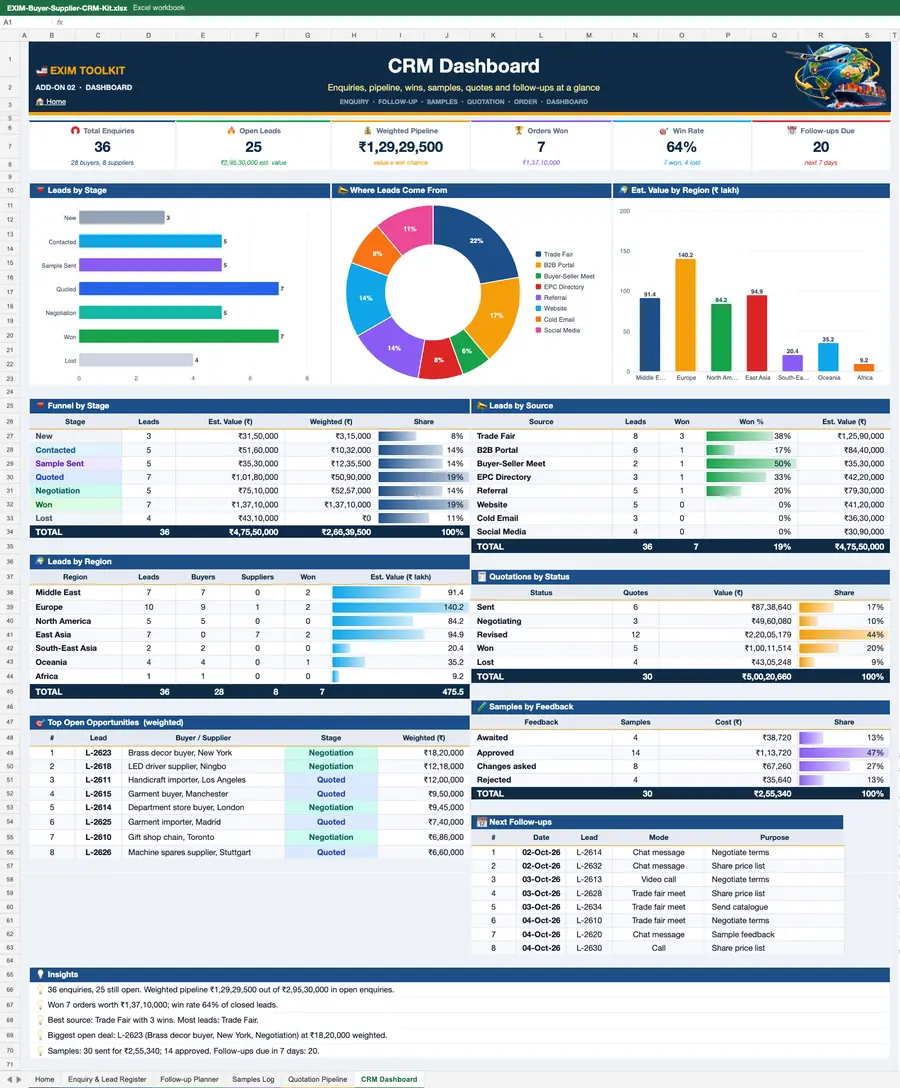
Within a month: call or message to ask what they thought of the sample, and offer the next step — a trial order, a video call with your factory, or a revised quotation. Keep a simple pipeline: contacted, sample sent, negotiating, order placed. Review it weekly until every lead has an outcome.
Buyers respect persistence and clarity. A supplier who follows up four times with useful information will win the order over a supplier who sent one email and vanished.
Cost and ROI: is exhibiting worth it?
A small stall at an overseas fair can cost ₹3–8 lakh all-in, and a larger one much more. That sounds like a lot until you compare it with the value of one new buyer. A single retail or wholesale buyer ordering ₹20 lakh a year repays the fair many times over.
Measure ROI properly. Track the total cost, the number of qualified leads, the number of sample requests, the number of trial orders and the value of orders placed within six months. A fair that produces two regular buyers is a success; a fair that produces only business cards is not, however enjoyable it was.
Cut costs without cutting results: share a stall with a complementary exporter, exhibit under your EPC's pavilion, attend as a visitor first to judge a fair before exhibiting, and use the fair's matchmaking service instead of paying for a large stand.
Finding buyers beyond the fairground
Fairs are one channel, not the only one. Between events, keep your pipeline full. Search the TodayAdviser export buyer directory for verified importers and buyers in your product category and country, and approach them with the same complete offer you use at fairs. Post a requirement (RFQ) on TodayAdviser so buyers looking for your product can find you, and answer buy leads quickly — the suppliers who reply first, with a price and a sample offer, are the ones who get shortlisted.
Frequently asked questions
Which trade fair is best for a first-time Indian exporter?
Start with a sector fair in India, such as IITF or your EPC's fair, where costs are lower and you can learn the ropes. Then exhibit at one overseas fair in your best market, ideally under your EPC's pavilion.
How much does it cost to exhibit at a trade fair?
A small Indian fair can cost under ₹1 lakh; an overseas fair typically costs ₹3–8 lakh including travel and freight. Subsidies from ITPO, EPCs or state schemes can reduce this significantly for MSMEs.
How do I get a list of buyers attending a fair?
Ask the organiser for the visitor profile and buyer list, use the fair's matchmaking app, and check your EPC — councils often receive buyer lists before their members do.
What is a buyer-seller meet?
A scheduled one-to-one meeting between an exporter and a pre-screened foreign buyer, usually organised by FIEO, an EPC or a government body. It is one of the most efficient ways to meet serious buyers.
How many buyers should I expect to meet at a fair?
A realistic target is 15–30 qualified meetings over three days. Quality matters more than quantity: five buyers who place trial orders beat fifty who take a brochure.
How soon should I follow up after a fair?
Within 48 hours, with the quotation and product details you discussed. Send samples within two weeks and chase a decision within a month.
Can small exporters afford trade missions?
Yes. Missions organised by FIEO, EPCs or state governments are often subsidised, and the cost per buyer meeting is usually lower than exhibiting alone.
Your next step
Pick one fair for the next six months, register, and start booking buyer meetings today. While you prepare, browse the TodayAdviser export buyer directory to find buyers for your products, or post a requirement (RFQ) on TodayAdviser and let verified buyers come to you.