Free and paid ways to find export buyers online, compared honestly — what works, what it costs, and how to turn clicks into real export orders.
Twenty years ago, finding an export buyer meant trade fairs, fax machines and a lot of patience. Today, an exporter in Moradabad or Tiruppur can find buyers in three continents before lunch — if they know where to look online. The problem is no longer access; it is choosing between dozens of free and paid methods, and knowing which ones actually produce orders.
This guide explains how to find export buyers online in 2026, comparing free and paid methods honestly: what each one costs, what it is good for, and how to combine them into a pipeline that keeps producing enquiries. Everything here is written for Indian exporters selling real products to real buyers.
Free method 1: B2B portals and marketplaces
B2B portals are the obvious starting point, because buyers come to them with intent. A buyer searching for "bulk basmati rice supplier India" or "cotton home textiles exporter" is already halfway to an order. Your job is to be visible, complete and quick to respond.
Start with two or three portals rather than ten. A half-finished profile on eight marketplaces produces nothing; a complete profile on two produces enquiries. Fill in every field: clear photographs, specifications, pack sizes, MOQ, certifications and an indicative price range. Mark prices as indicative and ask buyers to confirm live rates, because freight, duties and exchange rates move constantly.
The TodayAdviser buyer directory works from the other direction: instead of waiting for enquiries, you browse live buy leads posted by importers and respond to the ones that match your product. Spend fifteen minutes a day on it. The exporters who win online are rarely the ones with the biggest budgets; they are the ones who respond within a working day while competitors reply next week.
Free method 2: Google search and your own website
Many exporters ignore Google, yet importers use it constantly. A buyer in Germany looking for a new supplier will search in plain language — "organic turmeric powder bulk supplier India", "cast iron cookware manufacturer exporter" — and shortlist the suppliers who appear with clear product pages.
You do not need an expensive website. A simple site with one page per product, honest specifications, photographs, certifications and a contact form is enough. Write each page around the words your buyer would actually search for, and keep prices indicative. Add a short "export" page explaining your MOQ, payment terms and shipping experience. Over time, this brings you enquiries that cost nothing per lead — the cheapest buyer acquisition you will ever get.
Free method 3: LinkedIn and social media
LinkedIn is the best free tool for finding an export buyer by name. Search for import managers, procurement heads and category buyers at the companies you want to sell to, and send short, specific connection requests. Social platforms such as Instagram and YouTube also work for visually led products — handicrafts, home textiles, jewellery and food — where a short video of your production process can do more than a brochure.
The rule for all of it: be useful before you sell. Post about your products, your quality checks, your packing and your shipments. A buyer who has seen your factory on video is far more likely to reply than one who received a cold sales message from a blank profile.
Paid method 1: trade data subscriptions
Trade data is the most precise paid method available. Shipment records show which companies import your product, how often and in what volumes, and your product's HS code is the key that unlocks it. Paid databases such as ImportGenius, Panjiva, Volza and Indian shipment-data providers add company names and contact details to the picture.
Expect to pay an indicative range of a few hundred to a few thousand US dollars a year depending on coverage — verify live pricing before you subscribe. It is worth the money once you have a clear product and market: instead of guessing, you build a list of companies that already import what you sell. Start with a short trial or a single-country report before committing to an annual plan.
Paid method 2: ads and premium listings
Paid advertising can work, but only with discipline. Google Ads can put you in front of buyers searching for your exact product; LinkedIn ads can target procurement heads in a specific country; marketplace premium listings can push your products above free listings. Set a small monthly test budget, track cost per genuine enquiry (not per click), and stop anything that produces clicks but no conversations.
Premium listings on a marketplace are usually the safest first paid step: the audience is already buyers, and the cost is predictable. Paid ads are best used to support a product you already sell well, not to test an unproven product in an unproven market.
Comparing marketplaces honestly
No single marketplace suits every exporter. Large general portals offer reach but fierce competition, and many enquiries are low quality. Niche and verified directories, such as the TodayAdviser buyer directory, offer fewer but more serious leads. Social channels offer cheap reach but slow conversion. Trade data offers precision but costs money and needs skill to use.
Judge every channel by the same three numbers: genuine enquiries per month, conversations that reach quotation stage, and orders won. Review these quarterly and move your time and money towards the channels that produce orders, not the ones that produce activity. A spreadsheet with one row per channel and these three columns is all the analytics most exporters need.
Building a buyer pipeline and CRM
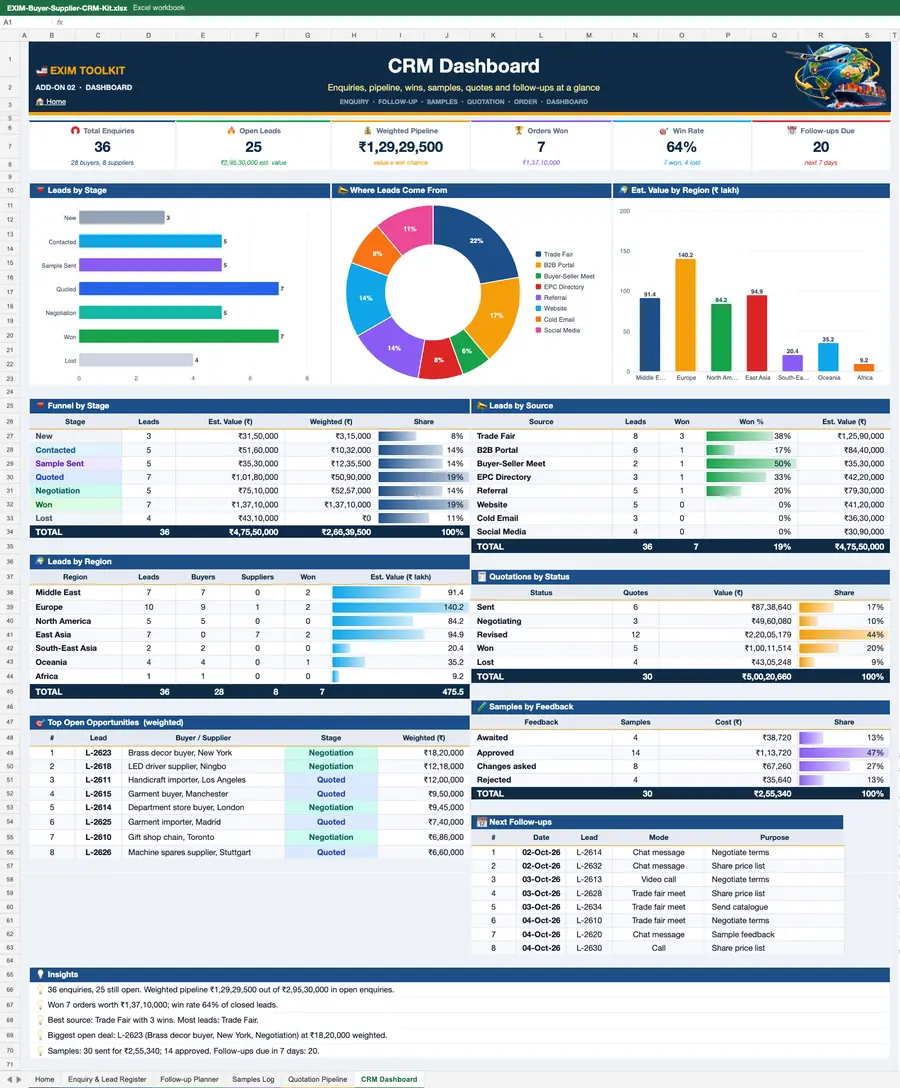
Finding buyers online is not a one-off task; it is a pipeline. Every enquiry, every LinkedIn conversation and every trade-fair contact should go into one system — even a simple spreadsheet at first, then a basic CRM as volumes grow. Record the buyer's name, company, country, product interest, date of last contact and next action.
Work the pipeline in stages: new enquiry, qualified (right product, right country, realistic volume), sample or quotation sent, negotiation, trial order, repeat order. Your goal is to keep every prospect moving one stage forward. Most export business is lost not to competitors but to neglect — a buyer who asked for a quotation and never heard back again.
Set a weekly rhythm: two hours finding new prospects, two hours following up, one hour updating listings. Small, regular effort beats occasional bursts. A pipeline with thirty live conversations is worth more than a thousand names on a bought list.
Outreach that gets replies: templates and follow-up
Good outreach is short, specific and personal. A first message that works looks like this:
"Hello [Name], I run [Company] in [City], India. We manufacture [product] and currently supply importers in [country]. Would you be open to receiving our catalogue and indicative price list for [product]? We work on [payment terms] with an MOQ of [quantity]."
That is four lines, and it answers the buyer's first questions. Adapt it per buyer — mention their country, their product range or a recent shipment. Never send the same generic message to fifty people; buyers can tell, and they ignore it.
Follow up on a simple cadence: day one, the first message; day four, a polite follow-up with one useful addition (a photograph, a certification, a price indication); day ten, a final short check-in. Then move on. Most replies arrive after the second message, and a graceful exit keeps the door open for later.
Verifying buyers before you ship
Online leads need verification before you spend money on samples or production. Check the buyer's company registration, website and trading history, and prefer company email domains over free webmail. Ask for trade references, start with a trial order on advance payment or an irrevocable letter of credit (LC), and use your bank or ECGC (Export Credit Guarantee Corporation) for credit checks and cover against non-payment.
Watch for the usual red flags: requests for upfront "registration fees" or "customs deposits", pressure to ship large first orders on open credit, and buyers who refuse every verification check. Genuine buyers do not charge suppliers to buy from them. Charge for large or customised samples where appropriate, and mark samples clearly for customs.
Find buyers faster with TodayAdviser
Free methods build your foundation; paid methods add speed and precision. The exporters who succeed online combine both: visible marketplace listings, a searchable website, LinkedIn outreach, trade-data shortlists and disciplined follow-up. If you want to start today, browse live import requirements on the TodayAdviser buyer directory and post your product requirement so verified buyers can find you.
Frequently asked questions
What is the best free way to find export buyers online?
B2B marketplace listings, the TodayAdviser buyer directory, Google search visibility and LinkedIn outreach. They cost time rather than money, and they work best together: a buyer who finds you on a marketplace will also check your website and LinkedIn profile.
Are paid buyer leads worth it?
Sometimes. Paid trade data and premium listings can be excellent value when you have a clear product and market. Be cautious with sellers of generic "buyer lists" — ask for a sample, check the data's date, and never pay for a list you cannot verify.
How much should I spend on finding buyers online?
Start free, then reinvest. Many exporters begin with free listings and outreach, then add one paid channel — usually trade data or a premium listing — once they have a product and market that converts. Track cost per genuine enquiry and cut anything that does not produce conversations.
How do I find buyers on Google?
Search as your buyer would: product plus country plus words such as importer, distributor or wholesale buyer. For your own visibility, build one clear page per product with honest specifications, photographs and indicative prices, written around the words buyers search for.
How long does it take to get export orders online?
For most new exporters working consistently, expect two to six months from first outreach to first order. Samples, negotiations and compliance checks take time. A steady weekly routine of outreach and follow-up shortens this considerably.
How do I avoid scams when finding buyers online?
Verify the company, use company email domains, ask for trade references, start small on advance payment or LC, and use your bank or ECGC for credit checks. Walk away from any buyer who asks you to pay fees to receive an order.