If you buy or sell steel in India, one question dominates every negotiation: what is the iron price per kg today? The honest answer is that there is no single price. Steel rates in India move daily, differ by product, city and quantity, and are quoted differently at retail counters, wholesale mandis and export desks. This guide explains how to read those quotes, what moves prices, the difference between retail, wholesale and export parity pricing, and how buyers can protect their margins — using indicative bands and trends, not made-up exact quotes.
A necessary disclaimer on prices
Steel prices change every day — sometimes more than once a day. Any specific number you read in an article, including this one, is out of date the moment it is published. Treat every figure below as an illustrative, indicative band that shows how the trade talks about price ranges, not as a quote you can buy at. Before placing an order, always verify live rates with two or three suppliers or a recognised price reporting source for your city and product.
How iron and steel prices are quoted in India
New buyers are often confused because the same material can be quoted three different ways:
- Per kg: the standard retail unit. A shopkeeper quotes TMT bars or angles per kg.
- Per tonne (1,000 kg): the standard wholesale and mill unit. Mill offers and trader deals are usually per tonne.
- Per piece or per length: common for TMT bars (per 12-metre piece) and structural sections.
To compare quotes, convert everything to per kg: divide a per-tonne price by 1,000. A per-piece quote needs the piece weight (for example, a 12m TMT bar of a given diameter has a standard weight per metre) before it can be compared per kg. Never compare a per-piece price with a per-kg price directly — it is one of the most common ways buyers overpay.
Indicative price bands: how the trade talks about ranges
Rather than exact numbers, experienced buyers think in bands. The illustrations below show the shape of typical bands — the distance between wholesale and retail, and between products — as they are often discussed in the trade during normal market conditions. These are illustrative examples, not live quotes.
- TMT bars (Fe 500 grade): retail counters often discuss bands spanning a few rupees per kg — illustratively, something like the high-40s to mid-50s rupees per kg in a soft market phase. Wholesale/mandi rates for truckloads typically sit a few rupees per kg below retail.
- Structural steel (angles, channels, beams): usually quoted a little above TMT — illustratively a band in the low-50s to low-60s rupees per kg at retail, with wholesale lower.
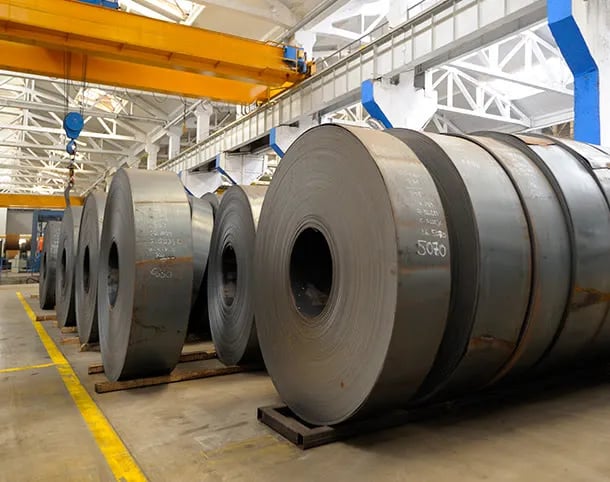
- HR coils / sheets: mill and trader offers are per tonne; converted, retail-equivalent bands are often discussed illustratively in the high-40s to high-50s rupees per kg depending on thickness and finish.
- MS scrap (melting): the bottom of the chain — illustratively discussed in bands around the low-to-mid-30s rupees per kg, moving with sponge iron and billet prices.
- Stainless steel (304 grade): a different universe — illustratively discussed in bands well above ₹150 per kg, driven by nickel prices.
The exact band positions shift with the market cycle. What matters for a buyer is the structure: wholesale sits below retail by a margin, scrap sits at the bottom, and value-added grades command premiums. Verify every live number before buying.
What moves steel prices in India
1. Coking coal and iron ore costs. Steelmaking's two biggest inputs. When global coking coal prices surge, Indian mills pass costs through within weeks.
2. Domestic demand cycles. Construction and infrastructure activity (roads, railways, housing), automotive production and capital goods orders drive offtake. Festival quarters and the pre-monsoon construction push are traditionally busy; monsoon months often soften demand and prices.
3. Global steel markets. India is deeply linked to world prices. A glut of cheap imported steel pressures domestic prices downward, while strong global demand pulls them up.
4. Currency movements. A weaker rupee raises the cost of imported coking coal and scrap, pushing domestic steel costs up.
5. Government policy. Import duties, safeguard measures, export duties on steel and iron ore, and infrastructure spending announcements all move sentiment and prices quickly.
6. Inventory and sentiment. Traders destock when they expect falls and restock when they expect rises — expectations alone can move mandi prices several rupees per kg in a week.
Retail vs wholesale vs export parity: three different prices
Retail price is what a local dealer charges for small quantities — per kg, inclusive of their margin, handling and often loading. It is the highest of the three and the most visible, but almost nobody buys container loads at retail rates.
Wholesale / mandi price is the trader-to-trader or mill-to-trader rate for bulk quantities — per tonne, ex-stockyard or ex-works. It moves first when markets turn and is the benchmark serious buyers track. The gap between wholesale and retail — the dealer's margin plus logistics — is typically a few rupees per kg, widening when demand is strong.
Export parity price is the price at which Indian steel can compete in world markets — roughly the international price minus freight, insurance, port handling and exporter margin, converted at the prevailing exchange rate. When global prices are weak, export parity can sit below domestic wholesale prices, which is why mills sometimes prefer exporting even at thin margins: it keeps furnaces running. When global prices are strong, export parity pulls domestic prices upward as mills divert volumes abroad.
For an importer or exporter, the key insight is this: your negotiating benchmark is wholesale or export parity, never the retail counter price.
How to read a steel price quote like a professional
A proper quote answers five questions. If any answer is missing, ask before comparing:
- Product and grade — TMT Fe 500 is not the same as Fe 550; HR coil thickness and width matter.
- Quantity and delivery terms — ex-works, ex-stockyard or delivered? A "cheap" ex-works quote plus freight can exceed a delivered quote.
- Payment terms — advance, LC or credit terms change the effective price.
- Validity — serious quotes carry a validity period (often same-day in volatile markets).
- Taxes — confirm whether GST is included or extra; it changes comparisons completely.
Practical buyer tips
- Track a benchmark, not just quotes. Follow a recognised price series for your product and city so you know whether a quote is high or low relative to the market — not just relative to the last supplier you called.
- Buy the dip in the cycle, not the panic. Monsoon-softened demand and year-end destocking often create buying windows. Avoid panic buying during sharp rallies.
- Split between mill and trader. Mills give the best base price for contracted volumes; traders give flexibility, credit and mixed loads. Most smart buyers use both.
- Lock prices for project work. If you are quoting a 6-month construction project, negotiate fixed-price or price-variation-clause supply — an unhedged steel exposure can erase your entire project margin.
- Verify weight, not just price. Under-weighment (bars lighter than the standard weight per metre) is a classic margin leak. Weigh a sample from every lot.
- Get everything in writing. Grade, quantity, rate, delivery schedule, payment terms and validity — on the purchase order, not on a phone call.
Frequently asked questions
What is the price per kg of iron in India in 2026? There is no single figure — it depends on the product (TMT, structural, scrap), the city, the quantity and the day. The trade discusses retail TMT in bands of a few rupees per kg and wholesale a few rupees lower. Verify live rates with suppliers before buying; any printed number is indicative at best.
Why do steel prices change daily? Because input costs (coking coal, iron ore, scrap), currency, global offers and trader sentiment all move continuously. Mills revise offers frequently, and mandi prices follow.
Is wholesale or retail cheaper for bulk buyers? Wholesale, always — by a margin of typically a few rupees per kg. Retail includes the dealer's margin and handling for small quantities.
What is export parity pricing? The price at which domestic steel can compete internationally — roughly the world price minus freight, insurance, port costs and exporter margin. It acts as a floor or ceiling on domestic prices depending on global market strength.
Should I buy now or wait? No article can answer that for your situation. Watch the trend in your product's benchmark series, check inventory levels with traders, and avoid buying large volumes at the top of a sharp rally. For project work, lock prices rather than gamble.
Conclusion
The iron price per kg in India is not one number but a structure: retail above wholesale above scrap, all of it moving with coal, demand, currency and global markets. Buyers who learn to read quotes properly, track benchmarks and verify live rates consistently buy cheaper than those chasing the lowest headline number. If you source steel or metals for your business, explore verified suppliers on TodayAdviser to compare live offers from mills and traders.